
使用预编译头文件
预编译头(PCH)是某些编译器支持的一项性能特性,用于编译一段稳定的代码,并将代码的编译状态存储在二进制文件中。在后续编译过程中,编译器将加载存储的状态,并继续编译指定的文件。 由于无需重新编译已生成的代码,因此每次后续编译都会更快。
qmake 在某些平台和构建环境中支持使用预编译头,包括:
- Windows
- nmake
- Visual Studio 项目(VS 2008 及更高版本)
- macOS、iOS、tvOS 和 watchOS
- Makefile
- Xcode
- Unix
- GCC 3.4 及以上版本
- clang
将预编译头文件添加到项目中
预编译头文件必须包含在整个项目中保持稳定且静态的代码。一个典型的预编译头文件可能如下所示:
// Add C includes here

#if defined __cplusplus
// Add C++ includes here
#include <stdlib>
#include <iostream>
#include <vector>
#include <QApplication> // Qt includes
#include <QPushButton>
#include <QLabel>
#include "thirdparty/include/libmain.h"
#include "my_stable_class.h"
...
#endif
注意: 预编译头文件 需要将 C 包含文件与 C++ 包含文件分开,因为用于 C 文件的预编译头文件不能包含 C++ 代码。
项目选项
要让项目使用预编译头文件,您只需在项目文件中定义PRECOMPILED_HEADER变量:
PRECOMPILED_HEADER = stable.hqmake 将处理其余工作,以确保预编译头文件的创建和使用。您无需在HEADERS 中包含预编译头文件,因为如果配置支持预编译头,qmake 会自动完成此操作。
针对 Windows 的 MSVC 和 g++ 配置默认启用precompile_header 。
使用此选项,您可以在项目文件中触发条件块,以便在使用预编译头文件时添加相应设置。例如:
precompile_header:!isEmpty(PRECOMPILED_HEADER) {
DEFINES += USING_PCH
}
若要在 MSVC nmake 目标中对 C 文件也使用预编译头文件,请将 `precompile_header_c ` 添加到CONFIG变量中。如果该头文件也用于 C++ 且包含 C++ 关键字/包含语句,请将其用 `#ifdef __cplusplus)` 括起来。
关于可能出现的问题的说明
在某些平台上,预编译头文件的文件名后缀与其他目标文件相同。例如,以下声明可能会导致生成两个同名的不同目标文件:
PRECOMPILED_HEADER = window.h
SOURCES            = window.cpp
为避免此类潜在冲突,请为将要预编译的头文件指定独特的名称。
示例项目
您可以在 Qt 发行版的examples/qmake/precompile 目录中找到以下源代码:
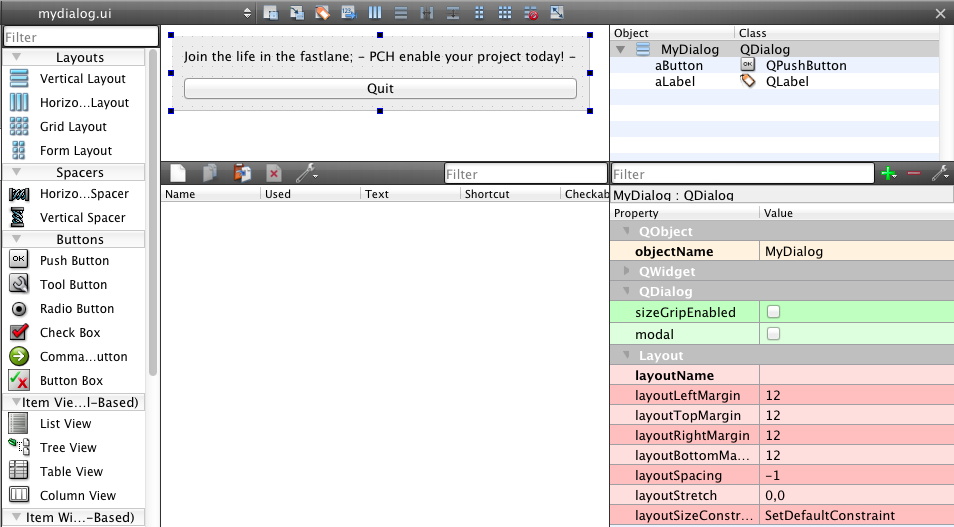
mydialog.ui
下图显示了Qt Creator 中 mydialog.ui 文件在“设计”模式下的界面。您可以在“编辑”模式下查看代码。
stable.h
/* Add C includes here */

#if defined __cplusplus
/* Add C++ includes here */

# include <iostream>
# include <QApplication>
# include <QPushButton>
# include <QLabel>
#endif
myobject.h
#include <QObject>

class MyObject : public QObject
{
public:
    MyObject();
    ~MyObject();
};
myobject.cpp
#include <iostream>
#include <QDebug>
#include <QObject>
#include "myobject.h"

MyObject::MyObject()
    : QObject()
{
    std::cout << "MyObject::MyObject()\n";
}
util.cpp
void util_function_does_nothing()
{
    // Nothing here...
    int x = 0;
    ++x;
}
main.cpp
#include <QApplication>
#include <QPushButton>
#include <QLabel>
#include "myobject.h"
#include "mydialog.h"

int main(int argc, char **argv)
{
    QApplication app(argc, argv);

    MyObject obj;
    MyDialog dialog;

    dialog.connect(dialog.aButton, SIGNAL(clicked()), SLOT(close()));
    dialog.show();

    return app.exec();
}
precompile.pro
TEMPLATE  = app
LANGUAGE  = C++
CONFIG   += cmdline precompile_header

# Use Precompiled headers (PCH)
PRECOMPILED_HEADER  = stable.h

HEADERS   = stable.h \
            mydialog.h \
            myobject.h
SOURCES   = main.cpp \
            mydialog.cpp \
            myobject.cpp \
            util.cpp
FORMS = mydialog.ui© 2026 The Qt Company Ltd. Documentation contributions included herein are the copyrights of their respective owners. The documentation provided herein is licensed under the terms of the GNU Free Documentation License version 1.3 as published by the Free Software Foundation. Qt and respective logos are trademarks of The Qt Company Ltd. in Finland and/or other countries worldwide. All other trademarks are property of their respective owners.
