
在基于小部件的应用程序中使用Qt Widgets
在基于小部件的应用程序中使用 2D 图表。
Graphs 2D仅支持Qt Quick 应用程序。本示例演示了如何在Qt Widgets 应用程序中,使用QQuickWidget 显示一个简单的2D饼图。
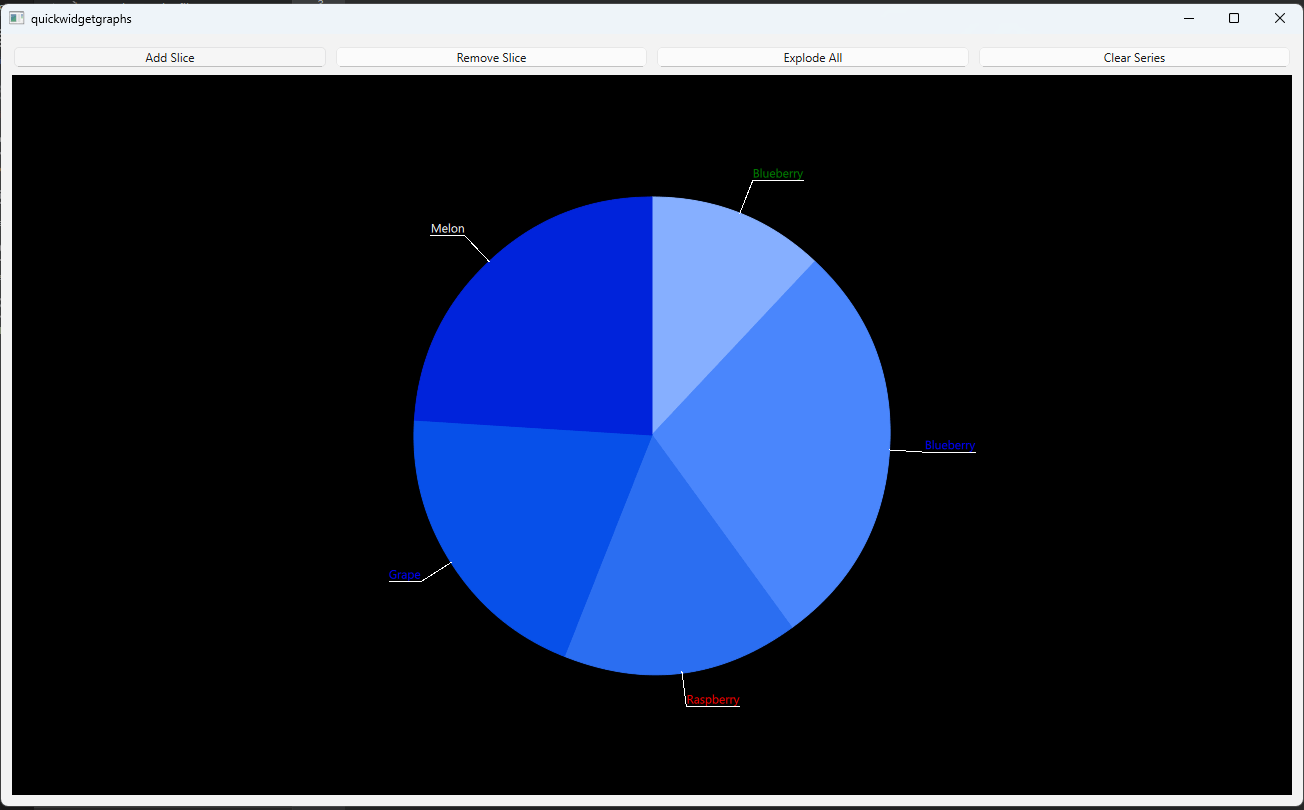
运行示例
您可以通过以下方式运行该示例:
- Qt Creator
打开Welcome 模式,并从Examples 中选择该示例。有关更多信息,请参阅Qt Creator :教程:构建和运行。
- Qt Extension for Visual Studio Code
在Command Palette 中运行Qt: Open Qt examples 命令,并从列表中选择该示例。有关更多信息,请参阅Qt Extension for Visual Studio Code :教程:构建和运行。
主视图
PieWidget类实现了演示应用程序的主视图。在PieWidget类中,实例化用于实现应用程序布局和UI元素的控件。m_quickWidget = new QQuickWidget; m_widget = new QWidget; m_vLayout = new QVBoxLayout(m_widget); m_hLayout = new QHBoxLayout; ...PieGraph类用于处理切片添加和移除的逻辑,并具备其他功能。m_pieGraph = new PieGraph; ...- 初始化按钮并将它们添加到布局中。
void PieWidget::initializeButtons()
{
    QPushButton *addButton = new QPushButton("Add Slice");
    QPushButton *removeButton = new QPushButton("Remove Slice");
    QPushButton *explodeButton = new QPushButton("Explode All");
    QPushButton *clearButton = new QPushButton("Clear Series");

    m_hLayout->addWidget(addButton);
    m_hLayout->addWidget(removeButton);
    m_hLayout->addWidget(explodeButton);
    m_hLayout->addWidget(clearButton);

    QObject::connect(addButton, &QPushButton::clicked, m_pieGraph, &PieGraph::onAddSlice);
    QObject::connect(removeButton, &QPushButton::clicked, m_pieGraph, &PieGraph::onRemoveSlice);
    QObject::connect(explodeButton, &QPushButton::clicked, m_pieGraph, &PieGraph::onExplode);
    QObject::connect(clearButton, &QPushButton::clicked, m_pieGraph, &PieGraph::onClearSeries);
}
操作图数据
PieGraph 类实现了本示例中所有用于操作 Graph 数据的逻辑。
- 在
PieGraph类中,声明一个pieSeries属性。... Q_PROPERTY(QPieSeries *pieSeries READ pieSeries WRITE setPieSeries NOTIFY pieSeriesChanged FINAL) ... - 编写用于添加、删除、展开扇区以及清除饼图系列的功能函数。
... public: ... void appendSlice(); void removeSlice(); void explodeSlices(); void clearSeries(); void fillSliceInfo(); public Q_SLOTS: void onAddSlice(); void onRemoveSlice(); void onExplode(); void onClearSeries(); ... - 在构造函数中实例化一个饼图系列,并添加几个扇区。
... m_pieSeries = new QPieSeries; fillSliceInfo(); for (int i = 1; i < 5; ++i) { QPieSlice *slice = new QPieSlice; slice->setValue(m_sliceInfo.value.at(QRandomGenerator::global()->bounded(0, 6))); slice->setLabel(m_sliceInfo.label.at(QRandomGenerator::global()->bounded(0, 6))); slice->setLabelColor(m_sliceInfo.color.at(QRandomGenerator::global()->bounded(0, 6))); m_pieSeries->append(slice); } m_pieSeries->setLabelsVisible(true); ... appendSlice函数会创建一个QPieSlice ,设置其部分属性,然后将其追加到饼图系列中。请注意,即使您已将标签的可见性设置为
true,此设置对后续添加到饼图系列中的扇区并不生效。您需要为每个添加的扇区在创建时将其可见性设置为true。QPieSlice *slice = new QPieSlice; slice->setValue(m_sliceInfo.value.at(QRandomGenerator::global()->bounded(0, 6))); slice->setLabel(m_sliceInfo.label.at(QRandomGenerator::global()->bounded(0, 6))); slice->setLabelColor(m_sliceInfo.color.at(QRandomGenerator::global()->bounded(0, 6))); slice->setLabelVisible(true); m_pieSeries->append(slice);- 在 `
removeSlice` 函数中,调用 `QPieSeries::remove()`。 - 在
explodeSlices函数中,遍历所有扇区,并根据当前状态将QPieSlice::setExploded() 设置为true或false。 - 在
clearSeries函数中,调用QPieSeries::clear()。这将删除饼图系列中的所有扇区。请注意,此函数不会删除饼图系列本身。
初始化 GraphsView
要自定义GraphsView 主题,请创建一个自定义的QGraphsTheme 。
auto theme = new QGraphsTheme(m_quickWidget);
theme->setTheme(QGraphsTheme::Theme::BlueSeries);
theme->setLabelBorderVisible(true);
theme->setLabelBackgroundVisible(true);
theme->setBackgroundColor(Qt::black);使用QQuickWidget::loadFromModule() 加载GraphsView 。通过将QGraphsTheme 和QPieSeries 传递给QQuickWidget::setInitialProperties(),初始化其theme 和seriesList 属性。
m_quickWidget->setResizeMode(QQuickWidget::SizeRootObjectToView);
m_quickWidget->resize(1280, 720);
m_quickWidget->setInitialProperties({
    {"theme", QVariant::fromValue(theme) },
    {"seriesList", QVariant::fromValue(m_pieGraph->pieSeries()) }
});
m_quickWidget->loadFromModule("QtGraphs", "GraphsView");© 2026 The Qt Company Ltd. Documentation contributions included herein are the copyrights of their respective owners. The documentation provided herein is licensed under the terms of the GNU Free Documentation License version 1.3 as published by the Free Software Foundation. Qt and respective logos are trademarks of The Qt Company Ltd. in Finland and/or other countries worldwide. All other trademarks are property of their respective owners.
