
PropertyAnimation QML Type
为属性值的更改添加动画效果。更多...
| Import Statement: | import QtQuick |
| Inherits: | |
| Inherited By: | ColorAnimation, NumberAnimation, QuaternionAnimation, RotationAnimation, SmoothedAnimation, SpringAnimation, and Vector3dAnimation |
属性
- duration : int
- easing
- easing.amplitude : real
- easing.bezierCurve : list<real>
- easing.overshoot : real
- easing.period : real
- easing.type : enumeration
- exclude : list<QtObject>
- from : variant
- properties : string
- property : string
- target : QtObject
- targets : list<QtObject>
- to : variant
详细说明
PropertyAnimation 提供了一种对属性值的变化进行动画处理的方法。
它可以通过多种方式定义动画:
- 在Transition
例如,要对因状态变化而更改了
x或y属性的任何对象应用动画效果,并使用InOutQuad缓动曲线:Rectangle { id: rect width: 100; height: 100 color: "red" states: State { name: "moved" PropertyChanges { target: rect; x: 50 } } transitions: Transition { PropertyAnimation { properties: "x,y"; easing.type: Easing.InOutQuad } } } - 在Behavior
例如,要对矩形
x属性的所有变化进行动画处理:Rectangle { width: 100; height: 100 color: "red" Behavior on x { PropertyAnimation {} } MouseArea { anchors.fill: parent; onClicked: parent.x = 50 } } - 作为属性值来源
例如,要反复对矩形的
x属性进行动画效果:Rectangle { width: 100; height: 100 color: "red" SequentialAnimation on x { loops: Animation.Infinite PropertyAnimation { to: 50 } PropertyAnimation { to: 0 } } } - 在信号处理程序中
例如,要在点击时淡出
theObject:MouseArea { anchors.fill: theObject onClicked: PropertyAnimation { target: theObject; property: "opacity"; to: 0 } } - 独立运行
例如,要让
rect的width属性在500毫秒内从当前宽度过渡到30:Rectangle { id: theRect width: 100; height: 100 color: "red" // this is a standalone animation, it's not running by default PropertyAnimation { id: animation; target: theRect; property: "width"; to: 30; duration: 500 } MouseArea { anchors.fill: parent; onClicked: animation.running = true } }
根据动画的使用方式不同,通常使用的属性集也会有所不同。有关更多信息,请参阅各个属性的文档,以及《 Qt Quick 中的动画和过渡》简介。
请注意,PropertyAnimation 继承自抽象类型Animation 。该类型包含用于控制动画的额外属性和方法。
修改正在运行的动画
从 Qt 6.4 开始,可以在顶级动画运行期间设置其from 、to 、duration 和easing 属性。动画将在下一个循环中应用这些更改。
另请参阅 《Qt Quick 》中的“动画和过渡”以及《Qt Quick 示例——动画》。
属性文档
duration : int
该属性存储动画的持续时间,单位为毫秒。
默认值为 250。
easing group
easing.amplitude : real
easing.bezierCurve : list<real>
easing.overshoot : real
easing.period : real
easing.type : enumeration
指定动画所使用的缓动曲线
要指定缓动曲线,至少需要指定其类型。对于某些曲线,还可以指定振幅、周期和/或过冲量(更多详细信息见表格后)。默认的缓动曲线是Easing.Linear 。
PropertyAnimation { properties: "y";
                    easing.type: Easing.InOutElastic;
                    easing.amplitude: 2.0;
                    easing.period: 1.5 }
可用类型包括:
Easing.Linear | 线性(t)函数的缓动曲线:速度保持恒定。 | 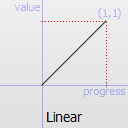 |
Easing.InQuad | 二次(t²)函数的缓入/缓出曲线:从零速度开始加速。 | 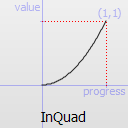 |
Easing.OutQuad | 二次(t²)函数的缓入/缓出曲线:从零速度开始减速。 | 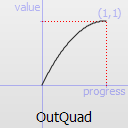 |
Easing.InOutQuad | 二次(t²)函数的缓和曲线:加速至中途,然后减速。 |  |
Easing.OutInQuad | 二次(t²)函数的缓动曲线:减速至行程一半,然后加速。 |  |
Easing.InCubic | 三次(t³)函数的缓动曲线:从零速度开始加速。 | 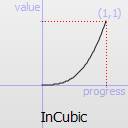 |
Easing.OutCubic | 三次(t³)函数的缓动曲线:减速至零速度。 |  |
Easing.InOutCubic | 三次(t^3)函数的缓动曲线:加速至行程一半,然后减速。 | 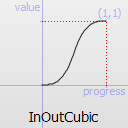 |
Easing.OutInCubic | 三次(t³)函数的缓入曲线:减速至中途,然后加速。 | 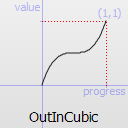 |
Easing.InQuart | 四次(t^4)函数的缓动曲线:从零速度开始加速。 | 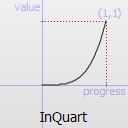 |
Easing.OutQuart | 四次(t^4)函数的缓入/缓出曲线:减速至零速度。 | 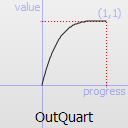 |
Easing.InOutQuart | 四次(t^4)函数的缓入曲线:加速至中途,然后减速。 | 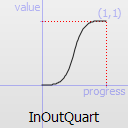 |
Easing.OutInQuart | 四次 (t^4) 函数的缓动曲线:减速至中途,然后加速。 | 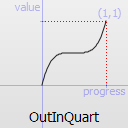 |
Easing.InQuint | 五次函数 (t^5) 的缓入/缓出曲线:从零速度开始加速。 | 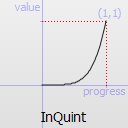 |
Easing.OutQuint | 五次(t^5)函数的缓动曲线:减速至零速度。 | 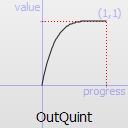 |
Easing.InOutQuint | 五次(t^5)函数的缓入/缓出曲线:加速至中途,然后减速。 | 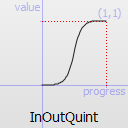 |
Easing.OutInQuint | 五次(t^5)函数的缓入/缓出曲线:减速至中途,然后加速。 |  |
Easing.InSine | 正弦(sin(t))函数的缓动曲线:从零速度开始加速。 | 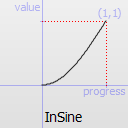 |
Easing.OutSine | 正弦(sin(t))函数的缓入/缓出曲线:减速至零速度。 |  |
Easing.InOutSine | 正弦(sin(t))函数的缓入/缓出曲线:加速至中途,然后减速。 | 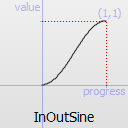 |
Easing.OutInSine | 正弦(sin(t))函数的缓动曲线:减速至中途,然后加速。 | 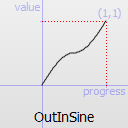 |
Easing.InExpo | 指数函数(2^t)的缓动曲线:从零速度开始加速。 | 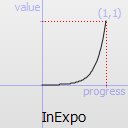 |
Easing.OutExpo | 指数函数 (2^t) 的缓动曲线:减速至零速度。 | 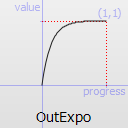 |
Easing.InOutExpo | 指数(2^t)函数的缓动曲线:加速至行程一半,然后减速。 |  |
Easing.OutInExpo | 指数函数 (2^t) 的缓入/缓出曲线:减速至中途,然后加速。 | 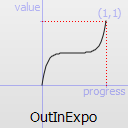 |
Easing.InCirc | 圆函数(sqrt(1-t^2))的缓动曲线:从零速度开始加速。 | 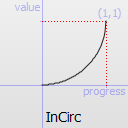 |
Easing.OutCirc | 圆函数(sqrt(1-t^2))的缓动曲线:减速至零速度。 | 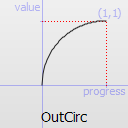 |
Easing.InOutCirc | 圆函数(sqrt(1-t^2))的缓入/缓出曲线:加速至中途,然后减速。 | 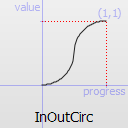 |
Easing.OutInCirc | 圆函数(sqrt(1-t^2))的缓动曲线:减速至中途,然后加速。 | 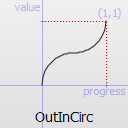 |
Easing.InElastic | 弹性(指数衰减正弦波)函数的缓动曲线:从零速度开始加速。 峰值振幅可通过振幅参数设置,衰减周期可通过周期参数设置。 | 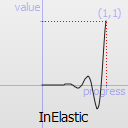 |
Easing.OutElastic | 弹性(指数衰减正弦波)函数的缓入/缓出曲线:减速至零速度。 峰值振幅可通过振幅参数设置,衰减周期可通过周期参数设置。 | 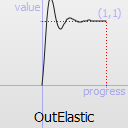 |
Easing.InOutElastic | 弹性(指数衰减正弦波)函数的缓动曲线:加速至一半,然后减速。 |  |
Easing.OutInElastic | 弹性(指数衰减正弦波)函数的缓入曲线:减速至一半,然后加速。 | 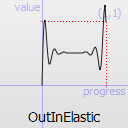 |
Easing.InBack | 回弹(过冲立方函数:(s+1)*t^3 - s*t^2)的缓入曲线:从零速度开始加速。 | 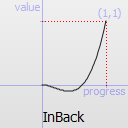 |
Easing.OutBack | 回弹(过冲立方函数:(s+1)*t^3 - s*t^2)淡出缓动曲线:减速至零速度。 | 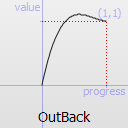 |
Easing.InOutBack | 回弹(过冲立方函数:(s+1)*t^3 - s*t^2)进出缓动曲线:加速至中途,然后减速。 | 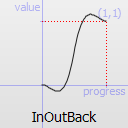 |
Easing.OutInBack | 回弹(过冲立方缓入/出:(s+1)*t^3 - s*t^2)缓入/出:减速至中途,然后加速。 | 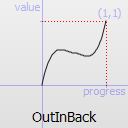 |
Easing.InBounce | 反弹(指数衰减抛物线反弹)函数的缓入/缓出曲线:从零速度开始加速。 | 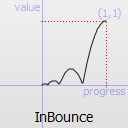 |
Easing.OutBounce | 反弹(指数衰减抛物线反弹)函数的缓动曲线:减速至零速度。 | 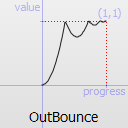 |
Easing.InOutBounce | 反弹(指数衰减抛物线反弹)函数的淡入/淡出缓动曲线:加速至中途,然后减速。 | 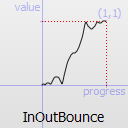 |
Easing.OutInBounce | 用于弹跳(指数衰减抛物线弹跳)函数的缓入/缓出缓动曲线:减速至中途,然后加速。 | 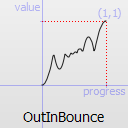 |
Easing.BezierSpline | 由 easing.bezierCurve 属性定义的自定义缓动曲线。 |
easing.amplitude 仅适用于反弹和弹性曲线(类型为Easing.InBounce 、Easing.OutBounce 、Easing.InOutBounce 、Easing.OutInBounce 、Easing.InElastic 、Easing.OutElastic 、Easing.InOutElastic 或Easing.OutInElastic 的曲线)。
easing.overshoot 仅当easing.type 为以下值时才适用:Easing.InBack 、Easing.OutBack 、Easing.InOutBack 或Easing.OutInBack 。
easing.period 仅当 easing.type 为:Easing.InElastic 、Easing.OutElastic 、Easing.InOutElastic 或Easing.OutInElastic 时才适用。
easing.bezierCurve 仅在 easing.type 为:Easing.BezierSpline 时适用。该属性是一个 list<real>,包含定义从 0,0 到 1,1 曲线的三个点组——控制点 1、控制点 2 和终点:[cx1, cy1, cx2, cy2, endx, endy, ...]。 最后一点必须是 1,1。
有关不同缓动设置的演示,请参阅“缓动曲线”。
exclude : list<QtObject> [read-only]
该属性用于指定不受此动画影响的项目。
另请参阅 PropertyAnimation::targets 。
from : variant
该属性保存动画的起始值。
如果PropertyAnimation 在Transition 或Behavior 中被定义,则该值默认为Transition 起始状态中定义的值,或者在Behavior 被触发时该属性的当前值。
另请参阅 Qt Quick 中的“动画与过渡”。
这些属性作为集合使用,用于确定哪些属性应进行动画处理。单数形式和复数形式在功能上完全相同,例如
NumberAnimation { target: theItem; property: "x"; to: 500 }与
NumberAnimation { targets: theItem; properties: "x"; to: 500 }单数形式经过了轻微优化,因此若您仅需对单一目标/属性进行动画处理,建议优先使用它们。
targets 属性允许设置多个目标。例如,以下代码会同时对itemA 和itemB 的x 属性进行动画处理:
NumberAnimation { targets: [itemA, itemB]; properties: "x"; to: 500 }在许多情况下,这些属性无需显式指定,因为动画框架可以自动推断出来:
| 值源 / 行为 | 当动画用作值源或用于“行为”时,默认的目标以及要动画化的属性名称均可被推断出来。 |
| 过渡 | 在过渡中使用时,属性动画被假定为匹配所有目标,但不匹配任何属性。实际上,这意味着您至少需要指定属性,动画才能生效。 |
| 独立使用 | 当动画以独立形式使用时,必须显式指定目标和属性。 |
如上例所示,properties 指定为要进行动画处理的属性名称的逗号分隔字符串。
另请参阅 exclude 以及 Qt Quick 中的“动画与转场”部分 。
to : variant
该属性存储动画的结束值。
如果PropertyAnimation 在Transition 或Behavior 中定义,则该值默认为Transition 的结束状态中定义的值,或触发Behavior 的属性change的值。
另请参阅 Qt Quick 中的“动画和过渡”部分。
© 2026 The Qt Company Ltd. Documentation contributions included herein are the copyrights of their respective owners. The documentation provided herein is licensed under the terms of the GNU Free Documentation License version 1.3 as published by the Free Software Foundation. Qt and respective logos are trademarks of The Qt Company Ltd. in Finland and/or other countries worldwide. All other trademarks are property of their respective owners.
